Tuesday, March 1, 2022

From the Journal of one Wigmar Heck, pt 35 (The Black Baron of Nuln)


32 Vorhexen

With the Countess safely back in the city it was time to get to work. To secure for myself  my just reward(s): more guns for my own army, a proper title, and a knighthood. In the Empire's long history men have been given more for less. But I'm not a greedy man, nor foolish enough to try to eat the entire cake in one sitting.

I also took it upon myself to modernize the Nuln army. For a city that produces so many fine guns its remarkably old-fashioned. Crossbows and halberds are fine for defending high walls protected by cannon but out in the field the new muskets will reign supreme. I know it!

Captain Hird and Herr Magister Frimm will oversee the initiative. Emmanuelle will pay for it. Good thing she's a rich woman - reequipping any army like this is almost as expensive as mustering a whole new army.

Nachhexen

Couldn't let the Countess be alone on Witching Night. Who knows what evils might have befallen her if denied my protection on this darkest of nights.

1 Nachhexen, 2499

Glorious New Year. I'm hung over. Weather atrocious. Will remain in the Countess' bed for the duration.

7 Nachhexen

I'm officially a Knight Griffon and a Baron of Nuln. It was a nice little ceremony, with the Countess making me her vassal first, and the chapter master of the Griffons knighting me after (they would not even consider me unless I was a peer of the realm).

The Barony isn't much in terms of lands or income but I'm now officially a peer of the realm. Isolde is my baroness and my children will follow in my footsteps.

The knighthood is a formality. Technically I'm sworn to defend all of Sigmar's flock (especially his priests and richly appointed temples), but chance of actually being called to arms is miniscule. 

2498 was the year Wigmar Heck reconnected with his ancestry and reclaimed his birthright.

2499 will be the year Wigmar von Liberungen starts to put his own mark on the Empire.


Thursday, February 24, 2022

Barony of Schwarzrauch


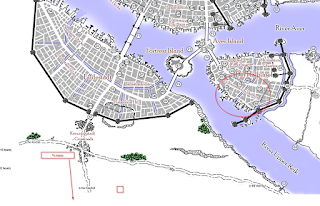
The Barony of Schwarzrauch (literally: the Black smoke barony) is a small fief a short ride outside the limits of Nuln. It comprises a small manor and adjoining buildings (where Wigmar spent some time the previous year), a few fields, and a forested hillock. It is is a recent creation (Nachhexen, 2499), granted to Baron Wigmar for services rendered unto the ruler of Nuln and Wissenland, Emmanuelle von Liebwitz. It is named for the so-called Schwarzrauch district in Nuln, where many of the cities gun foundries are located. The name is thought to be a way to honor Wigamar's interest in all things gun-powder related.


Thursday, February 17, 2022

Elixir of Life


The Elixir of Life is a magical concoction that features prominently in a thousand legends in the Empire and elsewhere. In some legends it gives the drinker a long, good life, free of sickness and pain. In others, it grants immortality. In the former case, a popular twist to the story is the drinker watching his wife and children die of disease or old age, then killing himself in despair. In the latter case, the immortality comes at a cost: madness, mutation, and vampirism are all on the table.

According to Ankh, Ankh-Akh gave the Elixir as a gift to the kings of Nehekhara, so that they and their families could lead long, good lives without fear of illness and injury. It was a gift he immediately regretted giving, because the kings were not satisfied. They wanted to rule forever. Thus the seeds of necromancy and undeath had been sown.

The Elixir of Life created by the Adlerverein is clearly of the "lesser" type.

Witch Hunters

The Empire is overflowing with hidden enemies. Mutants, cultists, and witches are everywhere. Bloodthirsty undead stalk the night. And the deep forests are home to greenskins, beastmen - and far worse things. It's not enough to watch the borders - a close eye must be kept on all citizens, all the time.

Enter the Witch Hunters. These men (and a few women) are a sad necessity of life. It's their job to hunt the hidden predators, to uncover the cults, and root out evil. Their gaze pierces lies and illusions. Their wit unravel the plots of their enemies. They do what lesser men dare not, can not do. They... wait just a minute... that's what the minstrels would have you believe. 

In truth, Witch Hunters are a mixed bag. While there are certainly some brave, skilled warrior-investigators out there, they are a shockingly small minority. Some witch hunters are little more than thugs, strutting through the towns and villages of the Empire, demanding adulation and obedience in equal measure. Others care little about guilt or innocence as long as they get to torture peasant girls and hang a few petty criminals. A few are outright frauds, pretending to do the work of witch hunters only to live off the locals.

Witch hunters are not above the law. They can't go around stealing or killing random strangers. What they can do is name someone a heretic, a mutant, a witch, or in league with the Dark Powers. Such individuals do not have the protection of the law and indeed anyone aiding and abetting them are subject to harsh punishments also.

Witch hunters have been around for as long as anyone can remember. They had a great upswing in authority and prestige under Magnus the Pious who demanded the temples aid his hand-picked men with rooting out hidden threats. There is currently no one source of witch hunters, no Imperial Inquisition so to speak. Instead, anyone can (in theory) be a witch hunter. That said, pretending to be a witch hunter isn't all that common. It could quickly become fatal if you confront real cults - or if the locals see through your bluff...

Here are some of the common sources of witch hunters:

Imperial Witch Hunters: These guys are sponsored by the Emperor. Their number has dwindled throughout the reign of Lutipold. It's a time of peace and stability, so the need for witch hunters is not that great, right? Their main advantage is that they "wield the authority of the Emperor," meaning they can expect help from local authorities throughout the Empire.

Sigmarite Witch Hunters: These guys are sponsored by the church of Sigmar. In the latter years of the 25th century they are becoming more common - and the temple has taken to cracking down on "false witch hunters." Like Imperial witch hunters they have a big advantage: the backing of a major temple that has a presence in almost every village throughout the Empire.

Verenean Witch Hunters: Few in number, these witch hunters are nevertheless quite effective. They use novel investigation techniques to uncover heresy and cut out the rot without damaging the host needlessly. They are also highly organized and share information with each other. Bova von Dunkelberg is an example. Peter Baden-Würt (the hanged witch hunter outside Unfer). Unfortunately they lack the innate authority of the Imperial and Sigmarite hunters.

Sponsored Witch Hunters: These are sponsored by local authorities. "Local" being anything from a local town council to one of the major provinces of the Empire. They can be just as effective (or ineffective) as other witch hunters, but lack any authority outside the immediate area.

Wednesday, February 16, 2022

Runefangs


The Runefangs are twelve ancient (presumably magical) swords forged by the legendary Dwarf Runesmith Alaric the Mad. The Runefangs are, after Sigmar's hammer, easily the most well-known weapons of the Empire.

The swords were intended for the twelve tribal leaders who had followed Sigmar. Today they are the badges of office of the Elector Counts of The Empire. Rarely wielded in combat, they have become regalia rather than weapons of war.

While there are twelve Runefangs, there are now only ten Elector Counts and provinces that remain. The realm of Drakwald (located in the Drakwald Forest) was destroyed and absorbed by Nordland and Middenland. Solland, the southernmost province, was sacked and destroyed in the early 1700s by Gorbad Ironclaw. The Elector was killed, and his Runefang was taken as a trophy by the ork warlord. Its current whereabouts are unknown.

The Runefangs

Unless otherwise noted the Runefangs are all heavy longswords (bastard swords) better suited to barbarian warfare than modern combat.

Averland - Mutters Verderben: Mother's Ruin is one of few Runefangs to be carried daily by an Elector-Count. It's also one of few to be regularly wielded in combat.

Drakwald - Bestienschlächter: Beast Slayer, the Runefang of Drakwald is kept in Altdorf under the protection of the Emperor and Sigmar. 

Hochland - Goblinfluch: The Bane of Goblins is said to be badly corroded after slaying a terrible Chaos beast during the Great War Against Chaos. 

Middenland - Beinbeißer: The legendary Leg Biter is the blade of the Todbringers, rulers of Middenland and Middenheim. It's likely that the Todbringer carries a replica in public.

Nordland - Krähenfresser: Crow Feeder is, like Stone Breaker, not a sword at all, but a bearded axe in the Norscan style. The lords of Nordland don't really talk about this much. Indeed, they always carry sword and axe together, so it's a moot point really.

Ostland - Kopfzerstörer: Head Chopper (or maybe Destroyer is a better word) is a mighty zweihänder that rests peacefully in the Great Hall in Wolfenburg. None of the Tassenincks have the might to wield it.

Ostermark - Trollspalter: The blade Troll Splitter is forged in the manner of a Kislevite cavalry sword, a heavy curved blade well suited for mounted murder. The weapon earned its name in Troll Country.

Reikland - Drachenzahn: Dragon's Tooth is the blade of Riekland and thus the blade of the current Emperor, Lutipold I, long may he reign. The number of heroic paintings and statues depicting the Emperor and his blade is quite large. As far as is known, the Emperor has never wielded the sword in anger - or been in a battle.

Solland  - Groll Siedler: Grudge Settler was lost to the orcs many years ago and never recovered, despite many claims to the contrary (every few years, someone claims to have found the blade). 

Stirland - Ork-Messer: Orc-Chopper is the twin of Mother's Ruin; the blades are so similar they are hard to tell apart. Unlike the Averland blade, its role is mostly ceremonial.

Talabecland - Steinbrecher: Stone Breaker isn't a sword at all, but a mighty warhammer, not entirely unlike Sigmar's. It sits silently in a vault somewhere; it's been generations since any lord of Talabecland had the strength to wield it.

Wissenland - Blutbringer: Blood Bringer is the sword of Emmanuelle von Liebwitz. She does not carry it in public (nor is she strong enough to wield it).

Knightly Orders


The Empire is home to many knightly orders, some of them new, some very old. There are literally hundreds of orders on record but the majority of them have long ceased to exist, or exist only as purely honorary institutions (being a knight has certain social benefits, so people with money sometimes purchase knightly ranks).

At the end of the 25th century there about two dozen orders that are still militant and sizeable enough to field knights on the battlefield. The heavy cavalry charge is doubtlessly still a powerful battlefield stratagem, but many orders have adapted to the changing times. They dismount to fight, act more like officers and NCO than rank-and-file, and even employ artillery.

Five orders are hands down the largest and most famous. They are listed here:

Notable Templar Orders

The Orders Templar are sworn to a specific deity. Even gods like Morr (why does the god of the dead need knights?) and Taal (a wilderness/rural god) have templar orders dedicated to them. Shallya is about the only major god NOT to have a templar order.

Knights Griffon: Sigmarites. Protects the Grand Theogonist, other high-ranking clergymen, and key temples. Still fields heavy horse. HQ: Nuln (in practice Altdorf)

Knights of the Blazing Sun: Powerful champions of Myrmidia. Still fields heavy horse but typically fight using modern tactics and weapons. HQ: Talabheim.

Knights of the White Wolf: Ferocious warriors of Ulric. Still fields heavy horse. Its heavy foot is among the Empire's finest. HQ: Middenheim.

Notable Secular Orders

Secular does NOT mean godless. The members of Secular Orders will honour most gods in an equal measure. It's just that they don't have a particular patron god.

Knights Panther: Ancient roots. Rose to prominence during the Arabyan Crusades. Dedicated to human purity and the eradication of mutants. In practice this often means crusading in distant lands, seeking glory and treasure. Still fields heavy horse. HQ: Near Carroburg, Middenland. Major chapter houses in Talabheim and Middenheim (the Knights Panther traditionally guard the Elector-Count of Middenland).

The Reiksguard: Bodyguards of the Emperor. Still fields heavy horse. HQ: Altdorf.

Knights Griffon


The Knights Griffon are among the Empire's most famous and easily recognizable knightly orders. The order was founded by none other than Magnus the Pious. It's job was to guard Magnus and follow him into the thick of battle against the Chaos hordes.

After the war, the Knights Griffon became the premiere guards of the Grand Theogonist and other high-ranking clergymen. This continues to this day. All members of the Knights Griffon are sworn to protect the priests and temples of Sigmar to their dying breath. That said, the Knights Griffon are not completely immune to political and honorific appointments. But even such appointees have to swear the same oaths and could (in theory) be called to battle in times of need.

When the Emperor moved his seat to Altdorf, the Grand Theogonist followed suit, and so did the bulk of the Knights Griffon. Still technically headquartered in Nuln, the Großmeister (Grand Master) resides in Altdorf and the "chapter house" there is bigger and more richly appointed that the one in Nuln.